Here’s an example I just drew for my RMCAD Children’s Book 1 class. Our introductory exercise is telling a wordless story in three panels answering the question “Why did the chicken cross the road?”

For a three-panel story, we establish a compelling problem in panel 1 and solve the problem in a satisfying way in panel 3. Panel 2 is where the character faces the problem and/or can see a solution. The middle should build on the beginning and result in the completion of the story.
Twists and surprises are how comics work. They lead us down one road and then solve in an unexpected way, but looking back, we can see the set-up was there all along.
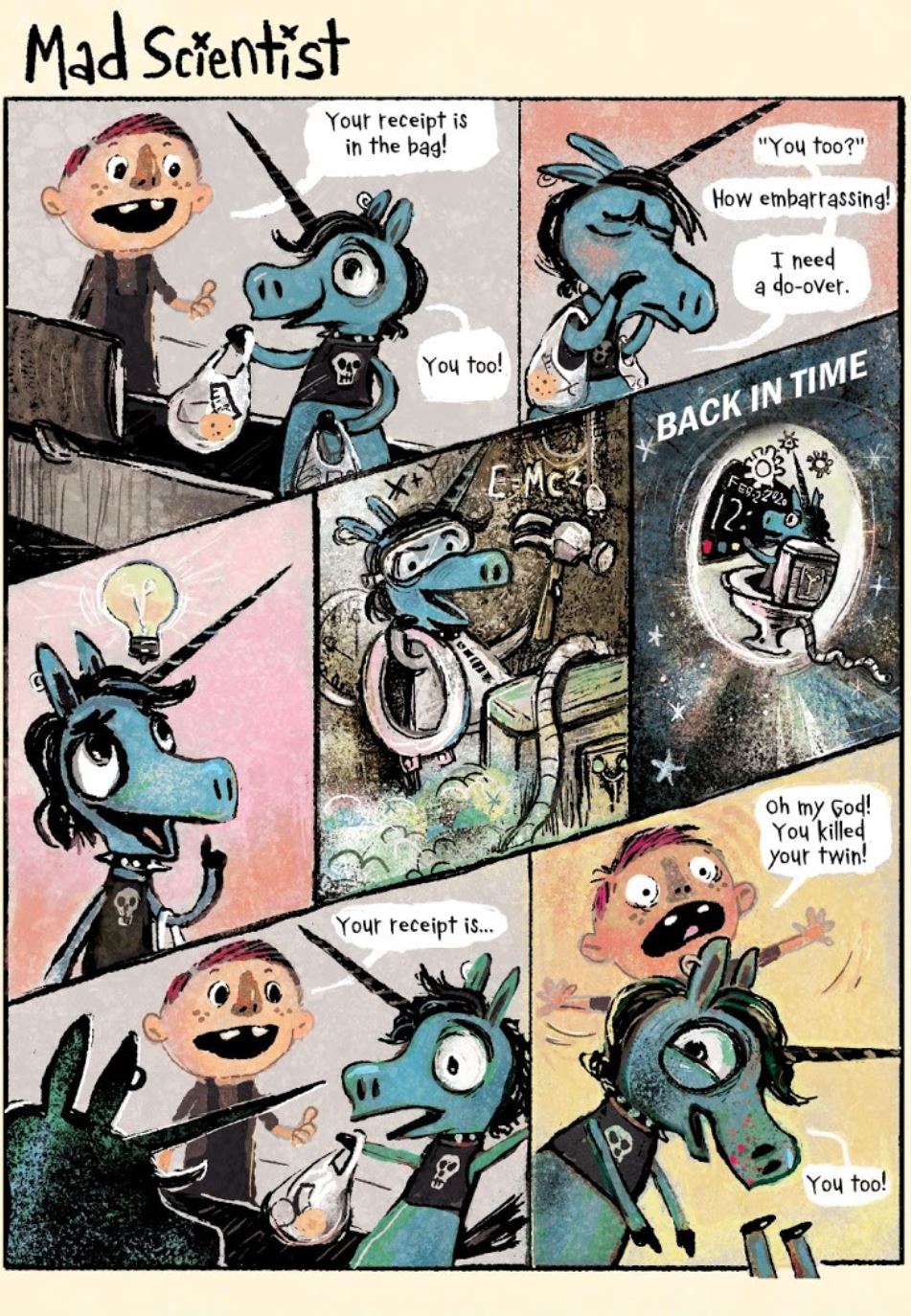
Here’s an example from my book, If UR Stabby. The beginning setup is the top row. We’ve established the problem. The second row is the middle. Stabby has come up with a way to accomplish the do-over he so desperately wants. He executes his plan. The bottom row shows the solution, which is maybe not what we thought it would be. Stabby is his own worst enemy– literally!
Try the three-panel chicken assigment for yourself! It’s a great way to get the hang of telling a sequential story with visuals only.
 The Kaz Windness Blog
Leave a comment