The number one issue I see when reviewing PB manuscripts is the writer doesn’t know what kind of book they are writing. This means the story or concept loses direction and becomes a mish-mash of too many things. To help writers sort this out, I’m compiling a list of book types and definitions. This will be updated periodically. Comment if you would add anything.
Fiction: “Learning Through Imagination!” Stories created from imagination, not presented as factual.
Non-Fiction (scroll to bottom of post for more NF examples): “True Stories” (Also nonfiction or informational.) “Any document or media content that attempts, in good faith, to convey information only about the real world, rather than being grounded in imagination. Non-fiction typically aims to present topics objectively based on historical, scientific, and empirical information.” (Wikipedia definition) Informational: Informational books provide accurate, factual information. Also called nonfiction books, many informational books are organized into sections and the vocabulary tends to be more complex. They often, though not always, use real photographs. Informational books are a great way to introduce science, health, engineering, history and geography topics to your child.
Narrative: Narrative books generally have at least one character, a problem and a plot that leads to resolution of the problem. Narrative books can foster imagination and help children see how characters deal with common fears, new situations and friendships. Fairy tales, classic stories, and many popular children’s stories, fall into this genre. Examples: Swim, Jim!, Bitsy Bat, School Star, and Bitsy Bat, Team Star (Kaz Windness). (Want to write a narrative book? See 3-Act Story structure, Hook! Plot! Pitch!)
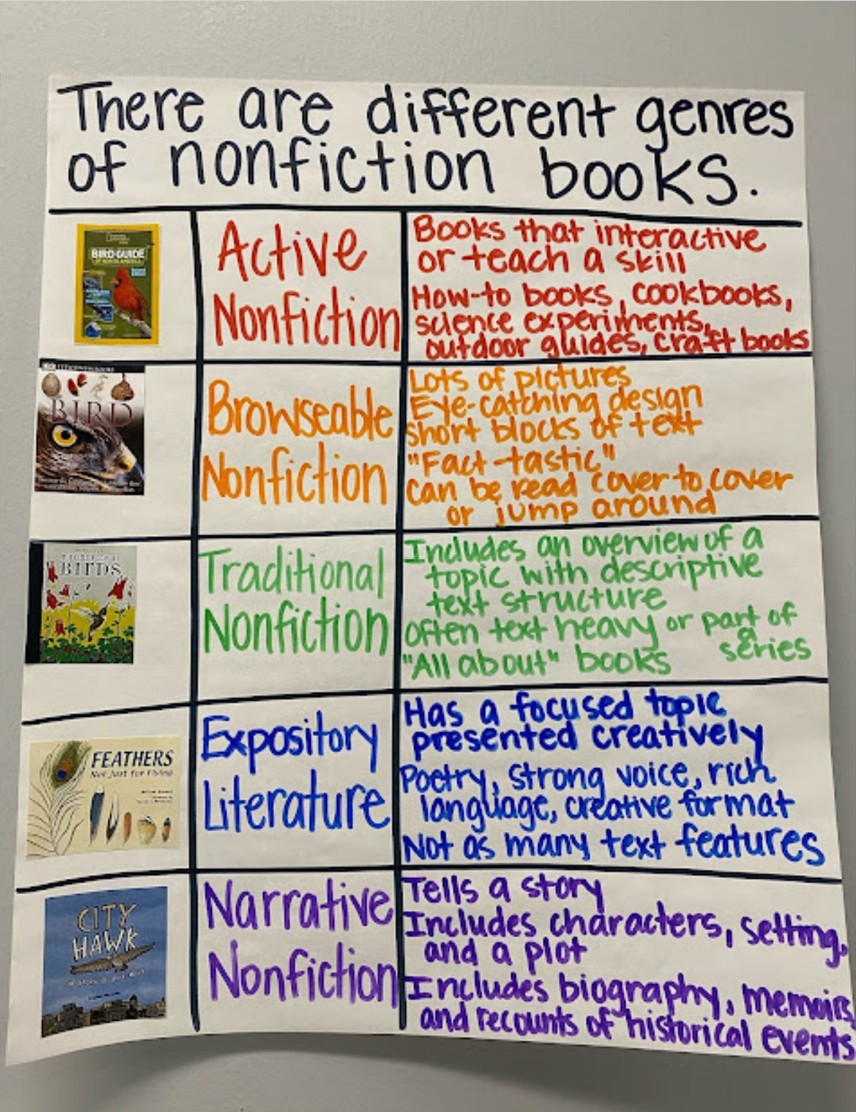
Narrative Nonfiction: It is written as a story with a character journey with tension (see: plot), but it is still based on factual information or events. If you plan to write a biography, a narrative nonfiction picture book is the way to go. These books are usually illustrated, as it can be hard to find photos for each scene. If you want to get the information across as not only facts, but through creative storytelling with emotional impact, then a narrative nonfiction picture book is preferable. As the name suggests, a narrative book presents your nonfiction topic through storytelling and reads almost like a fiction story. Examples: Shark Lady: The True Story of How Eugenie Clark Became the Ocean’s Most Fearless Scientist (Keating), If Sharks Disappeared, Lily Williams, JUMPER, Jessica Lanan.
Non-Narrative Fiction: Usually lyrical or rhyming text that makes a thematic statement. Does not have a specified main character facing a problem like in narrative fiction. Example: When You Love a Book (Windness/Brockman Lee) makes the statement “A book is a friend” and builds on this theme by showing examples of the profound way books shape us and become part of who we are, featuring clever nods to the most classic children’s books of all time. Other Examples: Oh, The Places You’ll Go (Suess), All Are Welcome (Penfold/Kaufman), The Day You Begin (Woodson/Lopez)
Quiet Book: Often for the younger picture book market, usually around a single topic or type of character) has no story, no stakes, no story problem. Still might follow an arc such as morning, afternoon, night or rising tension with a climactic moment, leading to a soft, satisfying story completion. Usually ends with gently going to sleep. (Can be a Bedtime Story.) Examples: Goodnight Moon or Breathe (Scott Magoon) about a young narwhal’s day. The Quiet Book series (Underwood/Liwska)
Wordless: A story that exclusively uses illustrations to tell the story. No text shown beyond the title and front or backmatter. Example: Wednesday Chris Van Allsburg.
This-or-That: Comparing and contrasting. Big/Small, Red/Blue. Can be a concept book teaching about shapes, colors, animals, etc. Example: One Fish, Two Fish, Red Fish, Blue Fish
Predictable: Repeated refrain, guessing what is next based on a pattern. Predictive books generally use repetitive words, phrases or sentences, rhyme and rhythm. The words and pictures are closely matched. Children are able to predict a repeated word or sentence pattern and, therefore, begin to join in during the reading. Examples: Brown Bear, Brown Bear, What Do You See? If You Give a Mouse a Cookie, The Pout-Pout Fish, Pete the Cat: I Love My White Shoes, Old MacDonald Had a Farm
Cumulative: These are rhythmic stories that are also categorized as predictable because the narrative builds on a pattern, usually with a repeated phrase that adds on the new element. Examples: There Was an Old Lady Who Swallowed a Fly, The 12 Days of Christmas
Concept Book: Most concept books do not have a main character, problem or plot. Instead, the concept or skill provides the book’s framework. Examples include alphabet books, number books, and books about colors and shapes. We may think that concept books are only for infants and toddlers, but some concept books, such as those related to number sense, are appropriate for preschool and kindergarten-age children. Example: Chicka Chicka Boom Boom is a rhyming alphabet concept book.
Seek-and-Find: Using illustrations or photos, seek-and-find books typically come with a written list or labels/images for children to find in the art. Examples: Where’s Waldo, The I Spy series. Where is Koketso (Nysha Williams).
List: Does not have a narrative story. Listing objects or observations. Example: Goodnight Moon (is also a Quiet Book.)
Epistolary: A book narrative told with a series of letters. Postcards count! Examples: Toot and Puddle, The Day the Crayons Quit, I Wanna Iguana, Dear Dragon
Meta: Meta-fiction. Self-aware. A narrative that depends on the character acknowledging the reader. Usually breaks the fourth wall. Main character or narrator has an understanding of the book format. Examples: The Monster at the end of this Book, The Book With No Pictures (Novak), I Am Bat (Hood)
Poetic or Lyrical: Using word sounds and rhythm and meter to tell the story in a musical way. Does not have to rhyme but can. See also Verse.
Verse: (in verse) Using a rhythm/meter/pattern of stressed and unstressed syllables as the writing structure. This may or may not rhyme but can use a rhyme scheme.
Rhyming: Using verse and a pattern of rhyming words. Perfect or exact rhyme is recommended for the picture book market. Dr. Suess is the most famous rhyming author, but utilizing current publications as mentor texts and comparables is recommended. Example: When You Love a Book (Windness/Brockman Lee). Note: Slant/near rhyme/forced rhyme are all publishing red flags. Perfect rhyme and meter is the standard.
Prose: Using plain speak. Usually used to distinguish writing format from verse.
Nursery Rhyme: Book based on a classic nursery rhyme. Examples: There Was An Old Lady Who Swallowed a Fly or Old MacDonald Had a Farm
High-Concept: A striking and easily communicable idea. Quickly understood and immediately compelling. Examples: The Day the Crayons Quit (Daywalt/Jeffers), Swim, Jim! (About a crocodile who’s afraid of the water. Kaz Windness)
Novelty: Includes an interactive element: lift-a-flap, pop-up, puppet, touch-and-feel, etc. Can also be identified as a book that is also a toy. Good article on these books HERE .
Board Book: For very young children, the pages are thick and sturdy paper pasted down to cardboard. These books are smaller and usually have fewer pages than a picture book. The term board book refers to the printing format rather than the topic of the book, which can vary.
SEL: Social Emotional Learning. Helps develop empathy and emotional IQ. Deals with emotional topics or feelings.
STEM: Science, Technology, Engineering, and Math. Books that have these focuses or topics. Can be fiction or non-fiction.
STEAM: Science, Technology, Engineering, ART, and Math. Adding the arts because they are crucial to understanding and application of STEM topics.
PB: Abbreviation for Picture Book.
GN: Graphic Novel. Book formatting utilizes comic panels and speech bubbles.
Early Reader/Leveled Reader, also Beginning, Emergent/Emerging, Primer, First, Bridge, Quick Fiction, and “Easy” (formatting terms): Early readers (ER) are a bridge between picture books and chapter books. Leveled Readers match a child’s reading level to books that meet and stretch them. Usually, the level is based on a child’s GRL (Guided Reading Level) or DRA (Developmental Reading Assessment), assessed in schools. Short Fiction or Quick Fiction is a contemporary term that helps older children with emerging reading proficiency feel more welcome when reading these titles. Easy Reader is an outdated term, as it is not “easy” for kids learning to read. Examples: Cat vs. Vac, Go! Go! Dino!, Squid in Pants by Kaz Windness.
Sometimes, Short Fiction or Quick Fiction is used by librarians to refer to shorter chapter books, so readers who aren’t ready for text-heavy chapter books can use this section without embarrassment.
High/Low or Hi-Lo: High Interest/Low Reading Level. These are books that cover subject matter of interest to older children who don’t yet have the reading skills to access the complexity of the text common for those topics. These books tend to have shorter word counts, shorter sentences, less text per page, more accessible vocabulary, and other supporting features, such as photos or illustrations. Every child deserves the chance to fall in love with books, even if they have a reading delay or disability, are learning English as a second language, or just haven’t met the book that wins them over yet. Examples: The Super Roomies: Lake of Slime by Jarret Lerner, TIME TRAVELING CHICKENS series by Kaz Windness.
Hybrid: Usually found in the middle-grade age category and containing a mix of text and images to tell the story. Examples: Diary of a Wimpy Kid by Jeff Kinney.
Library Categories:https://www.alsc.ala.org/blog/2021/10/a-deep-dive-into-picture-book-categories/
I’ve seen a variety of categories and subcategories, including but not limited to:
• Animals
• Celebrations or Holidays or Traditions (holidays, parties, and special events)
• Concepts or Basics (can include ABC’s, Colors, Numbers, Shapes, Size, Time, Opposites, Sign Language)
• Favorites (popular series, great read-a-louds, classics, award winners). I’ve also seen this as a catch-all for titles that don’t fit in a specific section
• Folk/ Fairy Tales
• Emotions or Ourselves or Growing Up or Me
• Fun and Games
• Nature (This I’ve seen as either weather and trees or even dinosaurs and animals)
• People or Community or Places or Alaska
• Play
• Pretty in Pink or Princesses
• Rhymes and Songs or Rhythm
• School
• Science
• Seek and Find
• Sights and Sounds
• Sports or Movement
• Superheroes
• Stories (This can take many directions with adventures, princesses, pirates, bedtime, or monsters).
• Transportation or Go Go Go
• Wordless
More NF examples and descriptions, provided by a school librarian:
 The Kaz Windness Blog
Leave a comment